
Summary
Spider veins are small, damaged blood vessels visible just beneath the skin, and for many people they are purely a cosmetic concern. For others, they are the first visible sign of an underlying circulation problem that will progress without treatment. The difference comes down to symptoms, and knowing which category you fall into determines both the treatment you need and whether insurance is likely to cover it. At Atlanta Medical Clinic, a vein evaluation starts with ultrasound imaging to determine what is actually happening beneath the surface, followed by a non-surgical treatment plan built around the findings.
Most people who notice spider veins on their legs assume the question is whether they care enough about the appearance to do something about it. That is a reasonable starting point, and for a large share of patients it is the whole story. But spider veins sit on a spectrum, and at the other end of that spectrum is vein disease that causes real symptoms and carries real health risks. This guide covers the full range, how to tell where you fall on it, and what treatment looks like at our Atlanta vein center.
What Are Spider Veins and Why Do They Develop?
Veins carry blood back toward the heart, and in the legs that means working against gravity. One-way valves inside the veins keep blood moving in the right direction. When those valves weaken, blood can pool and back up into the smaller vessels near the skin’s surface, causing them to dilate and become visible.
Spider Veins vs. Varicose Veins: What’s the Difference?
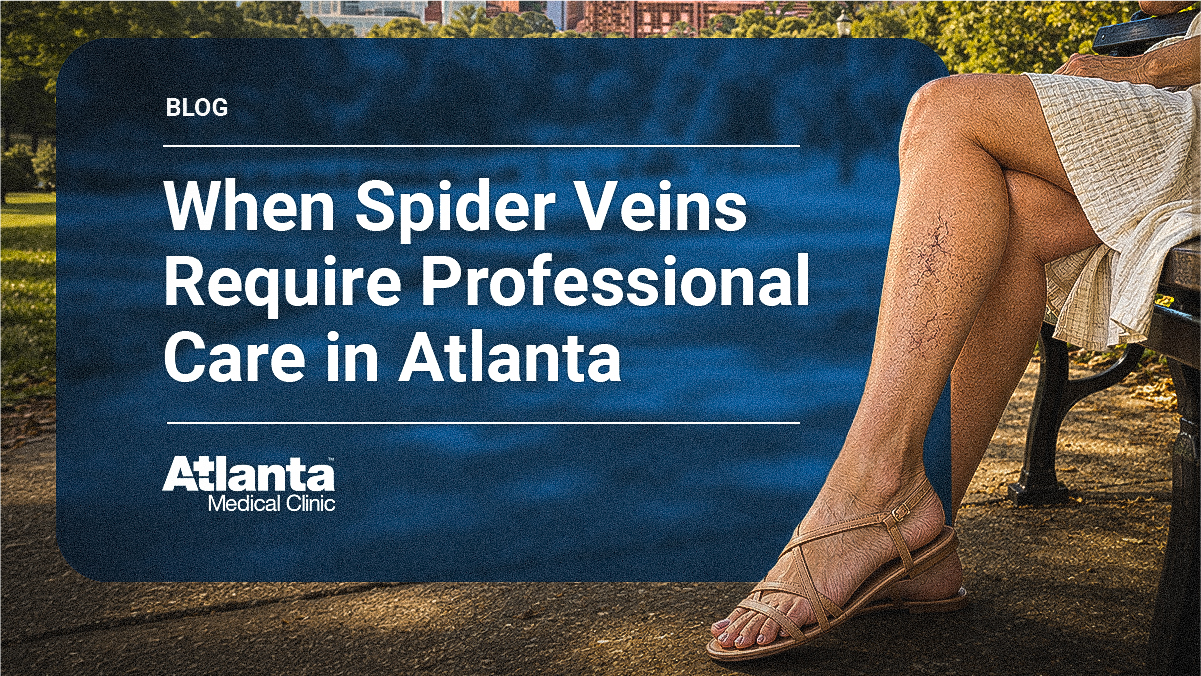
Spider veins are small, thin vessels close to the skin’s surface, usually red, blue or purple, often arranged in a web or branching pattern. They can appear on the legs or face and are typically flat or barely raised.
Varicose veins are larger, deeper and more prominent. They bulge visibly beneath the skin, often look twisted or rope-like, and appear almost exclusively on the legs. They are considerably more likely to cause discomfort.
One point worth clearing up: spider veins do not turn into varicose veins. They are related conditions with a shared underlying cause, but one does not progress into the other. What can happen is the reverse, where underlying venous insufficiency produces both.
Common Causes and Risk Factors
Several factors increase the likelihood of developing spider veins:
• Genetics. A family history of vein problems is one of the strongest predictors.
• Age. Vein valves naturally lose efficiency over time.
• Hormonal changes. Pregnancy, hormonal contraception and menopause all affect vein wall elasticity.
• Prolonged standing or sitting. Occupations that keep you in one position place sustained pressure on leg veins.
• Excess body weight. Added weight increases pressure on the lower-body venous system.
• Sun exposure. Particularly relevant for spider veins on the face.
Are Spider Veins Just a Cosmetic Issue?
For many patients, yes. Visible veins with no accompanying symptoms, no swelling and no discomfort are generally a cosmetic matter, and treating them is a personal choice rather than a medical necessity.
When Spider Veins Signal an Underlying Vein Disease
The picture changes when spider veins appear alongside other signs. Spider veins clustered around the ankles, in particular, are often associated with underlying venous reflux. When the deeper venous system is not working properly, pressure backs up into the surface vessels, and those visible veins become a symptom of something happening below rather than an isolated finding.
This is why a thorough evaluation matters even when the visible veins themselves look minor. Treating surface vessels without addressing an underlying problem tends to produce disappointing and short-lived results.
Symptoms That Indicate Your Veins Need Medical Attention
Visible veins accompanied by any of the following deserve a professional evaluation:
• Aching, throbbing or a heavy, tired feeling in the legs
• Swelling in the legs, ankles or feet, particularly at the end of the day
• Itching or burning around the affected veins
• Leg cramps, especially at night, or restless legs
• Skin changes, including darkening, thickening or dryness near the ankles
• Symptoms that worsen after long periods of standing and improve with elevation
Health Complications Linked to Untreated Vein Disease
Chronic Venous Insufficiency
Chronic venous insufficiency occurs when vein valves fail persistently enough that blood pools in the lower legs rather than returning efficiently to the heart. It is a progressive condition. Early stages produce swelling and heaviness; later stages bring skin changes and, eventually, ulceration. Catching it early is considerably easier than managing it after it advances.
Deep Vein Thrombosis (DVT) and Circulation Risks
Poor circulation in the legs increases the risk of blood clot formation. Superficial thrombophlebitis, a clot in a surface vein, causes a hard, tender, reddened cord along the vein. Deep vein thrombosis is more serious: a clot in a deep vein can break loose and travel to the lungs.
Warning signs that warrant immediate medical attention include sudden swelling in one leg, significant calf pain or tenderness, warmth and redness over the area, or any chest pain and shortness of breath.
Skin Changes, Ulcers, and Other Advanced Symptoms
When venous insufficiency goes untreated long enough, the skin around the lower legs and ankles begins to change. Brownish discoloration appears as blood pigment leaks into surrounding tissue. The skin may thicken and harden. In advanced cases, venous ulcers develop, open wounds that heal slowly and tend to recur. These are difficult to treat and far easier to prevent.
How Are Vein Conditions Diagnosed at Atlanta Medical Clinic?
Ultrasound Evaluation and What It Reveals
Diagnostic ultrasound is the foundation of a proper vein evaluation. It is noninvasive, painless and shows what a visual examination cannot: the direction of blood flow, whether valves are functioning, and whether reflux is present in the deeper venous system.
This is the step that separates a cosmetic concern from a medical one. Two patients with identical-looking spider veins can have completely different ultrasound findings, and those findings determine the right treatment approach.
What to Expect at Your First Vein Appointment
Your first visit includes a physical examination of the affected areas, a review of your symptoms, medical history and family history, and diagnostic ultrasound where indicated. We will discuss what the findings mean, what treatment options are appropriate, and whether your situation is likely to meet medical necessity criteria for insurance purposes.
Wear or bring shorts, since the examination requires access to your legs.
Vein Treatment Options at Our Atlanta Vein Center
Sclerotherapy for Spider Veins
Sclerotherapy remains the standard treatment for spider veins. A solution is injected directly into the affected vessel, irritating its lining and causing it to collapse. The body then gradually reabsorbs the closed vein, and blood reroutes through healthier vessels nearby.
Sessions are brief and performed in-office. Most patients need more than one session depending on how many veins are being treated, and results develop gradually over several weeks.
ClariVein for Varicose and Spider Veins
ClariVein combines mechanical and chemical approaches in a single catheter-based treatment. A rotating tip disperses a sclerosing agent along the vein wall while treating it mechanically, which allows effective closure without the thermal energy used in heat-based methods. That means no tumescent anesthesia and less discomfort for many patients.
Venclose RFA (Radiofrequency Ablation)
For larger varicose veins and significant venous reflux, Venclose radiofrequency ablation delivers controlled radiofrequency energy through a thin catheter to heat and seal the vein closed. Blood immediately reroutes through healthy veins. The procedure is performed in-office, takes under an hour in most cases, and patients walk out the same day.
Compression and Supportive Therapies
Compression stockings do not eliminate existing veins, but they support circulation, reduce swelling and relieve symptoms. They are frequently used alongside procedural treatment and during recovery, and most insurers expect a documented trial of conservative therapy before approving procedural coverage.
Cosmetic vs. Medical Vein Treatments: Understanding the Difference
The distinction is clinical, not arbitrary. A medically necessary treatment addresses a condition that causes symptoms or threatens health. A cosmetic treatment improves appearance without an underlying medical indication.
Will Insurance Cover Your Vein Treatment?
Coverage generally depends on documented medical necessity. Most insurers look for symptoms affecting daily function, ultrasound evidence of venous reflux or insufficiency, and a documented trial of conservative treatment such as compression therapy, usually over a period of several weeks to a few months.
Treatment of spider veins alone, with no symptoms and no underlying reflux, is typically considered cosmetic and not covered. Treatment of symptomatic varicose veins with documented reflux is frequently covered.
Coverage varies significantly between plans, and our team can help verify your specific benefits before you commit to treatment. Having the ultrasound performed is the necessary first step either way, since that is what establishes which category you fall into.
What to Expect During and After Vein Treatment
Recovery, Results, and Long-Term Vein Health
Our vein treatments are minimally invasive and performed in-office, with most patients returning to normal activities the same day or the next. Compression stockings are typically recommended during the initial recovery period, along with walking and light movement to support circulation.
Results develop gradually. Treated veins close and fade over weeks rather than days, with continued improvement over several months. Symptom relief, when symptoms were present, often comes sooner than the visible change.
Treated veins do not return. New veins can develop over time, since the genetic and lifestyle factors that caused the original problem do not go away, which is why maintaining healthy circulation habits matters long term.
Why Choose Atlanta Medical Clinic as Your Vein Specialist in Atlanta?
We offer the full range of non-surgical vein treatments in one place, which means your treatment plan is built around your diagnosis rather than around a single procedure a clinic happens to offer. Our evaluations begin with diagnostic ultrasound rather than a visual assessment alone, so cosmetic and medical cases are distinguished properly from the start.
Treatments are performed in-office in a modern facility, with same-day options and minimal downtime, and our team works with patients on insurance verification before treatment begins.
When Is It Time to See a Vein Specialist?
Warning Signs You Shouldn’t Ignore
Schedule an evaluation if you notice:
• Visible veins that are spreading, darkening or increasing in number
• Leg swelling that persists or worsens through the day
• Aching, heaviness or fatigue in the legs after standing
• Skin discoloration or texture changes around the ankles
• Any open sore or slow-healing wound on the lower leg
• Spider veins clustered around the ankles
And seek immediate care for sudden one-sided leg swelling with pain, warmth and redness, which can indicate a clot.
Whether your concern is cosmetic, medical or you genuinely are not sure which, an evaluation will tell you. Schedule a consultation with Atlanta Medical Clinic to find out what is actually happening with your veins and what your options are.

0 Comments